Guide to Issuing a D6 Religious Visa for Inviting Religious Workers
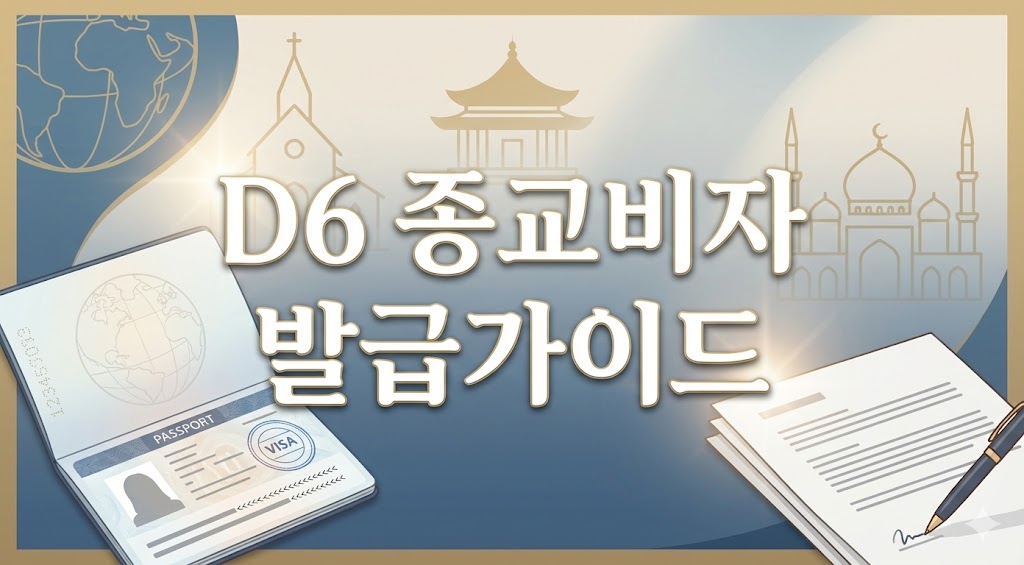
Guide to D6 Religious Visas for Domestic Religious Activities and Issuance Requirements
Foreign clergy seeking to enter Korea for the purpose of spreading spirituality or engaging in social service for a corporation or organization located in Korea must obtain a D6 religious visa. This post systematically outlines the specific scope of this qualification and points of caution that can easily be overlooked during the preparation process.
1. Definition and scope of application of D6 religious visa
This residency status is granted to individuals dispatched from overseas religious organizations or social welfare organizations to perform duties at relevant domestic branches. Specific categories are as follows:.
- If you are transferred from an overseas organization to a registered branch in Korea
- When a foreign religious group is dispatched to a domestic organization with a similar character to conduct missionary work or research.
- If you wish to stay for the purpose of religious study or religious life at the recommendation of a domestic organization
- If you are invited to a certified welfare organization and want to focus solely on social contribution work
2. Required supporting documents for visa application
The documents required during the screening process may vary depending on the applicant's circumstances, but generally, the following materials must be prepared:.
- Visa application form and copy of valid passport
- A standard photo taken within the last 6 months
- A letter of explanation describing the purpose and necessity of the invitation
- Dispatch certificate issued by the overseas headquarters organization
- Copy of the establishment permit of the domestic inviting organization
- The organization's business registration certificate or unique number certificate (including both parent corporation and detailed organizational information)
- A certificate of support for living expenses proving the ability to pay expenses during the period of stay in Korea
- A lease agreement or accommodation confirmation that can prove your residence
- Personal guarantee certificate
3. Things to keep in mind for smooth approval
To avoid delays or rejections due to procedural errors, please check the following in advance.
First, the qualifications of the inviter are crucial. Individual chapels or individual clergy cannot be inviters; they must be a legally incorporated organization, such as a denomination or parish.
Second, actions aimed at gaining economic gain are restricted. Since the D-6 visa is not for profit-seeking, it does not provide a regular wage, but only allows for the minimum living expenses necessary for the activity.
Third, you must confirm your entry route. With the exception of certain countries (such as Canada and Germany), you generally obtain a visa through the Korean embassy in your home country. Changing your status within Korea is extremely difficult.
Finally, the applicant must be able to objectively prove that he or she is a formal minister of the religion in question (ordination certificate, priest certificate, etc.).
4. Scope of work that can be performed by the person holding the qualification
After obtaining a visa, in addition to activities at the designated institution, you can work in the following areas:.
- Religious lectures and guidance in educational institutions
- Interchange of D-6 and E-1 (professor) work within the same foundation network
- Voluntary service within the scope that does not conflict with the original purpose
The D-6 visa process requires meticulous verification of the organization's credibility and the applicant's identity. If you have any questions during the preparation process, seeking expert assistance can be an efficient solution.